Saturday, August 27, 2011

Idul Fitri: Festivity of charity and forgiveness


Here comes Idul Fitri again, when more than 15 million people will go on mudik (homecoming) to celebrate the day of forgiveness. After a full month of fasting, Muslims will celebrate the post-Ramadhan (Idul Fitri) festivities.

Borrowed from Arabic, id means to be back and al-fitri means pure, nature, or disposition, suggesting a kind of “back-to-nature” status. According to Islam, a newborn is clean without any original sins. Islam teaches that naturally and biologically a newborn has the disposition to be good.

It is the parent who is responsible for making him or her good or otherwise. Clearly, from an Islamic point of view, early childhood education is the first and most important phase of education. Character and charity develop over a life time, but it starts at home. The home environment is the filter by which subsequent values and qualities are processed.

The fasting month teaches introspection, compassion with the hunger and social solidarity. People have to refrain from consuming food and drink, which are otherwise halal (lawful and permissible) from sunrise till dawn in other months. The moral is clear: You dare not compromise your own rights, let alone others’. Should they internalize and implement the essence of fasting, Muslims would not be dishonest or commit corruption.

By completing the month-long fasting, Muslims are now reborn to set a new life. The Idul Fitri festivity is meant to celebrate victory over desire, lust and impulse during Ramadhan. After Ramadhan, they are supposed to be mindful that all these are worldly temptations that could trap and push them toward disaster.

During Ramadhan, Muslims are obliged to give food or money to the poor. It is narrated that the Prophet Muhammad was generous and during Ramadhan was most charitable. As tough as the fasting month may have been, the feeling of being reborn — without sin — is so strong among true Muslims so they are already looking forward to another Ramadhan to come.

Muslims are encouraged to share their prosperity with others. Muslims are reminded of the saying by the Prophet Muhammad, that the true possession is the charity contributed to others. The act of giving brings happiness both to the giver and receiver. The more you give the happier you are.

To err is human, but to persistently commit wrongdoing is mischievous and self-damaging. The more you commit wrongdoing, the more depressed and miserable you are. Wrongdoing is a symptom of mental illness. The month of forgiveness comes down to you once a year to guide you back to the straight path. By nature (fitrah) humans have disposition to be good.

Feeling poor and destitute, some people erroneously think they possess nothing to give. As a matter of truth everybody controls forgiveness treasured in the heart. Everybody makes mistakes that are psychologically burdensome. To forgive and to be forgiven equally generate relief and happiness on both parties.

Ramadhan, in comparison to other months in the year, is like Friday to other days in the week. Regardless of social status — rich or poor — all Muslims celebrate. Muslims are obliged to give obligatory charity (zakat fitrah) before performing the Idul Fitri prayer. The purpose is to share prosperity with the poor so that they could also celebrate.

The bottom line is that the spirit and attitude of giving optional charity (sedekah) and forgiveness are to be materialized in the other months throughout the year. Muslims need Ramadhan just like vehicles need an overhaul. It renews their faith to energize life commitments to social solidarity and performing noble deeds.

We tend to overlook the role played by maids and servants. How could we survive without them? Housewives agree that without them household tasks just fall apart. Mudik is a recurring social phenomenon inseparable from Ramadhan. And when maids and servants are on mudik, we realize that the poor are another pillar of society. Their role is simply irreplaceable by machinery.

Due to arrogance and self-overestimation many people lose sight of the greatness in their maids and servants. By way of tobat (asking for God’s forgiveness) your sins could be forgiven for, say, not performing vertical worship, such as fasting and daily prayers.

On the contrary, violating ethics of horizontal worship such as social interaction is to be settled socially through silaturahim, which literally means establishing compassion. The Prophet Muhammad said that silaturahim would lengthen your age. This is to suggest that interaction and negotiation develop harmony and brotherhood.

The Idul Fitri festivity is not the end. Government offices, social institutions, even small-scale communities regularly hold a halal bihalal, an Arabic-like expression coined to refer to a social gathering held a few weeks after the Idul Fitri festivity. Again, the mission is to institutionalize silaturahim. The Presidential Palace usually holds it after the Idul Fitri prayer, where high-ranking officials, regardless of their faith and religion, are invited. Political and bureaucratic silaturahim perhaps!

If you are abusive or violent toward your maids or servants, you have to ask for their forgiveness. It is them who have the right; God would not forgive you for them. Forgiveness from a maid or servant could be the only key for abusive and violent bosses and housewives to open the gates of Paradise!

As Muslims break the fast of the last day of Ramadhan, they begin takbir, which literally means to magnify greatness of God by reciting Allahu Akbar; God is great, in a loud voice in groups or individually until sunset on the day of Idul Fitri.

The moral: No matter how powerful and authoritative you are, you are dependent on others. Takbir is a divine reminder to Muslims. Humans are created equal. It is God who is great. In His eyes the noblest one is one — regardless of social status — who fears Him most. Takbir educates us to be modest, respectful and polite.

While it was formerly hypothesized that growth in science would reduce dependence on religion, the Ramadhan phenomenon verifies that both religion and science go hand in hand. Fasting is medically curing, forgiving is psychologically satisfying and mudik and halal bihalal are socially rewarding.

By A. Chaedar Alwasilah, Bandung professor at Indonesian Education University, Bandung.

Friday, August 26, 2011

Indonesia and Reform: SBY Could Borrow Brazil's Broom


Last weekend a group of 29 public figures sent an open letter to President Susilo Bambang Yudhoyono deploring the culture of corruption that permeates Indonesia and warning of systematic attempts by the bureaucracy and vested interests to destroy the Corruption Eradication Commission. This is a public rebuke to a president whose political campaign was built upon his credibility, integrity and unwillingness to tolerate corruption.

With his popularity declining and his credibility under constant assault, especially with the daily unfolding drama concerning the case of graft suspect and Democratic Party lawmaker Muhammad Nazaruddin, Yudhoyono would do well to take a page out of Dilma Rousseff’s playbook.

Rousseff is the president of Brazil, a large and proud country that shares similar problems to Indonesia: entrenched systemic corruption among its politicians and bureaucrats, a high poverty rate and a legislature comprised of multiple parties.

Similar to Yudhoyono, she is also heading a ramshackle coalition government comprised of parties ranging from communists to right-wing populists, though most of them simply have no ideology at all. The Economist newspaper bluntly described the main interests of these small parties as “extraction of jobs and money — for personal gain or party financing — from government.” Many Indonesians can relate to that kind of description.

Unlike Yudhoyono, who won his second term decisively with 61 percent of the vote, Rousseff started from a fragile position. Se had never held elected office before and her victory came thanks to her riding the coattail of her popular predecessor, Luiz Inacio Lula da Silva. Even with his blessing, she did not win the election straightaway, but in a runoff poll. Considering her position, many predicted her presidency would be weak, dominated by Lula, and that she would just be a four-year placeholder for the former president so he could skirt the constitutional presidential term limit and run again.

Yet she has proved her doubters wrong. She has tolerated no drama in her administration, immediately firing her chief of staff when he became too much of a distraction due to his past influence-peddling. His firing was followed by the mass firings of many officials implicated in graft investigations, including three cabinet ministers. Later, the minister of defense was fired after saying he was “surrounded by idiots” in an interview.

While many of her critics were justified in arguing she took action only after media investigations cast a spotlight on the misconduct, none of these critics disagreed that such decisive actions were needed to maintain both public and investor confidence. In fact, recent surveys show that even though her popularity took a beating due to an economic slowdown and rising interest rates, her tough handling of the scandals and her fight against extreme poverty has kept her public support rating at a high point of 70 percent.

It is still too early to judge whether Rousseff’s presidency will be successful in its quest to eradicate corruption and poverty, but what is clear is that people are willing to support leaders who challenge entrenched interests and clean up the Augean stable of political and bureaucratic corruption.

Yudhoyono started his term from a very strong position. He had a strong mandate, with a clear majority of the electorate supporting him, citing his willingness to tackle corruption. At one point, Yudhoyono’s popularity was at 85 percent, meaning that in theory he could do just about anything he wanted to push for much-needed reforms. While the fractured legislature was often cited as the main reason Yudhoyono had to be very cautious in pursuing reforms, the body was one of the state’s most unpopular institutions. Its paltry 24 percent support rating paled in comparison with Yudhoyono’s stratospheric support, meaning the president could pressure and bully the legislature into passing reforms.

Despite his advantages, Yudhoyono, unlike Rousseff, seemed to have no seriousness in tackling the issues of corruption, governmental waste and bureaucratic machinery, or in getting rid of ministers in the habit of putting their feet in their mouths.

Yudhoyono’s inability to act decisively caused the government to be paralyzed every time a scandal erupted or somebody said something stupid. Not surprisingly, Yudhoyono’s popularity declined steadily as people tired of his wishy-washiness.

To make the situation worse, Indonesia desperately needs drastic reforms to curb waste and inefficiency. As Finance Minister Agus Martowardojo has noted, many provinces in Indonesia spend a bulk of their budget on civil servants’ salaries — one province spends a whopping 70 percent — leaving very little money for development.

Some 80 percent of district, provincial and village governments are also in debt, to the tune of Rp 7.8 trillion ($910 million). Such bloated bureaucracy will only add red tape and create more waste.

While Indonesia thankfully is still enjoying healthy economic growth, the question is for how long. With the market hammered every day with bad news coming from the euro zone due to the inability of European governments to form credible policy, the global economic crisis will only worsen and at some point in the future, Indonesia may have to make hard choices in order to survive.

Yet, the government might end up paralyzed due to a succession of crises. Marwan Jafar, the chairman of the National Awakening Party (PKB), has complained that there were seven drafts for important laws that remained untouched thanks to the Democratic Party’s distraction by the Nazaruddin scandal. Such governmental paralysis each time a scandal strikes is very troubling considering the worsening global economic climate.

Yudhoyono could have spared himself much grief had he acted decisively in the beginning by committing to clean up the government. With people perceived to be his close colleagues making statements undermining the authority of the Corruption Eradication Commission, and by seemingly turning a blind eye to accusations of corruption among his close confidants and his own party, he is undermining his own credibility, and prompting people to question his commitment to reform a rotten system.

By Yohanes Sulaiman lecturer at the National Defense University

Brave New Singapore


Wow, a real election!


Singaporeans go to the polls tomorrow to vote in what for the first time appears to be a real election – for the presidency, a largely ceremonial post that now could become considerably less ceremonial.

Perhaps the most interesting thing about the race is that it is a national one, extending across the entire island. The PAP has been able to engineer districts and group constituencies so that it holds 81 of the 87 elected seats in the Parliament despite receiving only 60.1 percent of the vote in parliamentary elections held earlier this year. For what appears to be the first time, Singapore is involved in a straight contest that should provide a true test of the government’s popularity. It is not possible to gerrymander the presidency.

There are four Tans running. The most interesting is Tan See Jay, who was once principal private secretary to then-Prime Minister Goh Chok Tong before eventually joining the Singapore Democratic Party – the opposition. The second is Tony Tan, the smooth political face of modern Singapore and the PAP.

Because the president can’t belong to a political party, Tan See Jay has resigned from the SDP. His campaign to become a non-PAP president includes checking absolute parliamentary control by the PAP with “moral pressure on the PAP government by speaking up.” He claims that his presidential campaign can “raise the profile of all non-PAP forces and this will help in our outreach to the people in the run-up to 2016,” when the next general election is due.

It would be interesting to see how Singapore, and especially the Lee family, which has in effect run the country since independence, would handle it if Tan See Jay wins.

Singapore has all of the notional trappings of democracy – an elected parliament, a judicial system theoretically in place to keep the parliament honest, regular parliamentary debate, regularly scheduled elections, a privately-owned press, multiple newspapers and television stations, a strong civil service in which promotion is a meritocracy. The elections are clean, the votes counted scrupulously, all of the forms observed in a legalistic and orderly society that has none of the hallmarks of violence or vote-buying that have blighted democracies in the Philippines or Thailand or any of the other countries in Southeast Asia.

But is this a democracy? In a democracy, all of the eligible voters are expected to have an equal say in the decisions that affect their lives, with theoretically equal participation in the proposal, development and passage of legislation into law. But through a long series of threats against districts that go against them, electoral regroupings and gerrymandering, the PAP has managed to keep a hold on parliament that could far outweigh its actual popularity with the voters, given the party’s overwhelming parliamentary majority.

In large measure, the Singaporean government arguably has done a better job of governing than any other country in Southeast Asia, perhaps all of Asia. In a conventional sense, it is by far the least corrupt government in Asia and ranks with Finland and New Zealand at the top of Transparency International’s 2010 Corruption Perceptions Index. Its per capita gross domestic product by purchasing power parity (PPP) of US$62,100 is among the highest in the world. It has taken better care of its environment than any country in the region if not much of the world. Its education system excels at producing skilled workers, although its schools have been criticized for its inability to produce creative ones.

This is after all a consumer society with access to almost any of the goods and services one needs or wants to maintain an upscale lifestyle. Singapore has often been described by its detractors as Orwellian, or even Kafkaesque. But it is neither of these. Its leaders do not seek to brutalize or bludgeon the population into submission but to lull them into a kind of self-satisfied acquiescence. It is more Huxleyan. As the British author and thinker Aldous Huxley said in his 1958 essay on his original 1931 novel Brave New World: “a completely organized society complete with a scientific caste system (and in Singapore’s case, a political caste system as well), methodical conditioning to eliminate or at least dull the exercise of free will, the orthodoxies drummed in by nightly courses of sleep-teaching.” That of course is a little over the top. In Singapore’s case, a full panoply of feel-good press, television and wholesome activities are designed to keep the constituents happy.

Its leaders are firm in pointing out that its newspapers and magazines can publish anything they want about the outside world—and given the nature of the news business, that is largely bad news, while Singapore remains a well-ordered oasis of hermetically sealed calm, since neither the international press nor especially the local ones are allowed to report anything bad.

Despite all of that, there are irritations in Singaporean society that spring directly from the lack of democratic leadership. It is clear that native Singaporeans resent the hundreds of thousands of émigrés being brought in from other countries. There are about 1.5 million temporary workers in Singapore today. Non-citizens comprise 36 percent of the population.

There is the question of how much the political leaders pay themselves – by far the highest salaries in the world. There is the question of state capitalism – more than 60 percent of the means of production is owned by the state, a classic definition of socialism rather than capitalism.

There are some signs that the government, concerned that Tan See Jay might actually be elected, which even so is believed to be a long shot, would seek to circumvent his decisions. The Law Minister says his decisions are to be “guided” by the advice of a panel of presidential advisors who are appointed and/or nominated by the government or the cabinet. So what role would the president then play?

With Singapore’s highly paid ministers and civil servants, do they have accountability and willingness or preparedness to step down from policies that have failed to deliver or failed to meet their mark? Temasek Holdings and other GLICs have made vast losses and their executives have not been forced to account for their failures. No journalist would ever demand in Singapore that a government official step down unless the government was to order a press campaign.

One supposes real democracy, as the late US President John F. Kennedy once said of the citizens of East Berlin, involves their tendency to vote with their feet. In Singapore they have done, in numbers that have alarmed the government. Asia Sentinel

Stiff Philippine Libel Law Used Against Journalist


Supreme court justice goes after a respected author


Marites Danguilan Vitug, a respected Filipina journalist, was forced to post P10,000 bail Friday on criminal libel charges that she had defamed Supreme Court Justice Presbitero Velasco in a recent book.

Vitug and her supporters had hoped that the prosecutor would decline to file charges, which Velasco first demanded in 2009. The justice took exception to an assertion that he had helped the congressional campaign of his son, Lord Allan Velasco, who beat out Edmondo Reyes Jr., the scion of a political family and an ally of former President Gloria Arroyo in the 2010 congressional elections.

It is believed to be the first time that a Philippine Supreme Court justice has filed such a case against anyone including a journalist, Vitug said. That makes it questionable how the case can proceed through the lower courts, since the 15-person high court polices the legal system.

Under the Philippines criminal libel laws, truth alone is not a defense and conviction can result in a jail term of up to four years. The law presumes up front that malice is present in every defamatory imputation, “even if it be true, if no good intention and justifiable motive for making it is shown,” according to the statute. Thus the prosecution need not prove malice on the part of the defendant, for the law already presumes that the defendant’s imputation is malicious (malice in law). The burden is on the side of the defendant to show good intention and justifiable motive in order to overcome the legal inference of malice.

The laws have been used by a long series of Filipino politicians and business figures including Miguel “Mike” Arroyo, the former president’s husband, to attempt to quell critical reporting. Arroyo filed 43 complaints seeking P70 million against editors, publishers and reporters in 2006 and 2007, earning a denunciation from the international press protection organization Reporters Without Borders for hounding reporters and "eroding press freedom in the Philippines." Most of the stories contained allegations of corruption on the part of the president and her husband. Eventually, all of the suits were dismissed.

“If we are found guilty, we’ve got to go to prison,” Vitug said in a telephone interview. “But it is not common for journalists to be convicted in the Philippines. The courts work very slowly, there have only been two cases so far of journalists who have actually spent time in jail, and the sentences have been short.” It is not clear at this point when the case will come to trial, said Vitug, who chairs the advisory board for the investigative journalism operation Newsbreak.

The use of such libel laws is especially effective against smaller publications, radio and television stations in provinces far from the capital, according to Melinda de Jesus of the Center for Media Freedom and Responsibility in Manila in an earlier interview. At one point, de Jesus told Asia Sentinel, 150 criminal libel suits were filed against one paper in a single year.

"There used to be a period when basically you felt if you had a libel case filed against you, you were hard-hitting and it was worn like a purple heart," de Jesus said. "We do have a highly complex, multilayered system, in terms of the time and process it takes for an issue to go through. But that has not affected how quickly public officials file cases. Of most of the cases filed, few end in convictions."

In the book, Vitug quoted residents of the Marinduque constituency as saying the Supreme Court justice was active in organizing his son’s ticket, inviting two local officials to run with his son as councillor and promising to underwrite campaign expenses, and that he was also present in Allan’s meetings with local leaders in his beachfront residence in Torrijos, Marinduque. Asia Sentinel

Thursday, August 25, 2011

Malaysia's Slowing Performance


There are strong institutional reasons for the lagging performance against its regional neighbors


In the 70 years since World War II ended, East Asian economies, including Malaysia, appear to have largely got performance right. Malaysia was also one of 13 countries identified by the Commission on Growth and Development in its 2008 Growth Report to have recorded average growth of more than 7 percent per year for 25 years or more. Malaysia achieved this spectacular performance from 1967 to 1997.

However, since the Asian Financial Crisis of 1997 and1998, Malaysia’s economic performance when compared to previous decades has been lackluster and most macroeconomic indicators are trending downwards. This was confirmed by Prime Minister Najib Tun Razak himself in the publication on March 30, 2010 of the New Economic Model – Part 1. This was a very brave move but a necessary one by the premier as he acknowledged publicly the failures of Malaysia’s current economic model in order to demonstrate urgency for reforms.

The New Economic Model identifies domestic factors such as weak investor confidence, capability constraints (weak human capital, entrepreneurial base and innovative capacity) , productivity ceilings and institutional degradation and external factors such as a sluggish global economy caused by the global financial crisis of 2008-2009 and the rise of neighbors in the region in contributing to the declining growth trajectory.

If we were to revisit the determinants of growth and agree that proper institutions form the overall structure that determines long-term sustainable growth, then the logical response is to reform Malaysia’s institutional set-up, as it must be the deepest determinant of what is hindering economic growth.

This view is further strengthened as Malaysia’s other deep determinants, geography and trade, are favorable. The country has abundant natural resources, is shielded from natural hazards and is well-located strategically both geopolitically and economically. Malaysia has also benefitted tremendously from being an open economy, especially in the merchandise sector.

The New Economic Model also reports that regional challenges from China, India and Vietnam, etc. are a cause for Malaysia’s declining economic performance. What has changed about these countries? They have all undertaken institutional reforms: China since 1978, India since 1992 and Vietnam since 1986. They are reaping the benefits while Malaysia has stalled in its institutional reforms since the 1990s, regressed in some ways and is suffering from the consequences.

The above points stress the importance of institutional reforms in Malaysia, something that Najib has ironically neglected in his signature policies – 1Malaysia, Government Transformation Programme and Economic Transformation Programme.

According to the Growth Commission report, “…fast sustained growth is not a miracle; it is attainable for developing countries with the ‘right mix of ingredients.’ Countries need leaders who are committed to achieving growth and who can take advantage of opportunities from the global economy. They also need to know about the levels of incentives and public investments that are necessary for private investment to take off and ensure the long-term diversification of the economy and its integration in the global economy…”

Michael Spence, the Chairman of the Growth Commission, elaborated on his extensive experience working with developing countries on growth issues in his latest book by emphasizing two important characteristics for developing countries to ensure long term sustainable growth – the role of political leadership and democratic norms. He suggests four characteristics for governments that are necessary requirements to underpin long term growth:
1. The government takes economic performance and growth seriously.
2. The governing group has values that cause it to try to act in the interest of the vast majority of the people (as opposed to themselves or some subgroup, however defined)
3. The government is competent and effective and selects a viable sustained-growth strategy that includes openness to the global economy, high levels of investment, and a strong future orientation.
4. Economic freedom is present and is supported by the legal system and regulatory policy
Manifestations of Malay/Muslim Supremacy

Malaysia is classified as a non-democratic state by all international indexes measuring quality of democracy. This is also affirmed in academic circles. During the boom years, Malaysians accepted this tradeoff – restricted freedom for economic growth. Since 1997/98, this has changed as expected. The government has not delivered on growth, therefore the natural demand for reforms and by extension freedom.

There is consensus that Malaysia needs extensive economic, political and social reforms. This is all the more evident IF we agree that institutions are key to long term growth. Also, IF we agree with Spence, these reforms must come from a government with the four characteristics identified above.

Astute observers of Malaysia know the reasons why the present administration and the ones before were unable to make fundamental reforms. This has much to do with the ideology of Malay/Muslim Supremacy as defined by the United Malays National Organization (UMNO) and accepted by large swaths of Malaysians, Muslims and non-Muslims alike.

From the literature we can infer that the ideology of Malay/Muslim supremacy has provided the perverse incentives that have manifested themselves in many ways. The more critical ones are:
• Institutional degradation: The deterioration in the quality of Malaysia’s institutions, particularly during former Prime Minister Mahathir Mohamad’s years, such as the lack of independence between the branches of government; the politicization of the civil service, producing a culture of risk aversion and a lack of creativity; and the expansion of the non-transparent Government Linked Corporations (GLCs):
• Crony capitalism: Affirmative action in the name of Malays has become a smokescreen for crony capitalism. Affirmative action is the instrument for rampant elite-based (from all races, not only Malays) corruption. High levels of income inequality in Malaysia in general but more so within the Malay community prove this.
• Race based affirmative action: Race-based affirmative action in itself is recognized as one of the important reasons for Malaysia’s declining economic performance. Malaysia’s focus on the ex-post equalization of outcomes across ethnicities rather than ensuring effective ex-ante equalization of access to opportunities has had important direct efficiency implications, affecting growth by distorting incentives and thereby the competitive process.
• Excessive centralization: An interesting institutional feature is the lack of decentralization in the country, which is nominally a Federation and the top-down approach in public policymaking. This is a key disconnect in the reform rhetoric in the ETP and GTP. To strengthen public service delivery, local communities need to be empowered. Fiscal relationships between federal-state-local also demonstrates institutional failure.
• Feedback mechanisms: Related to Malaysia’s top-down approaches is an almost complete disregard for monitoring and evaluation. As a result there is little feedback from outcomes into policy design. The obsession with centralizing policy-making is also evident in lack of information sharing both within government and with the public.
The need to remove UMNO to create a new “people based ideology”

In relation to competency, the quality of the human capital base in Malaysia is suspect. This is due to the quality of education from preschool through tertiary and on-the-job training. It is linked with ethnicity issues and is exacerbated by the outflow of high-skill individuals and affected by the inflow of low-skill labor.

There are not only problems on the supply side of the market for skills, but also on the demand side, where firms may not be competitive enough to offer higher wages. The market for skills itself is also problematic in that the price mechanism does not work adequately and this is where wage-setting issues play a role.

A bigger and more important challenge than competency is the question of internal competition. This is quite distinct from external competitiveness, on which front Malaysia has scored relatively well in the merchandise sector given its stage of development and the nature of its manufacturing processes which are still dominated by competitiveness identified by low cost rather than high value.

Internal competition refers to the allocation of certain factors including labor, capital, land and product markets. Internal competition works well when there is good governance, openness and transparency. It relates to the need for deregulation, liberalization and competition policies especially in key areas such as government procurement and the activities of GLCs in the domestic economy.

All of these are also needed to produce effective competition for good ideas and good policies as well as competition in the political arena. This of course challenges the basic idea of meritocracy and affirmative action in Malaysia.

To reform these will ostensibly mean changing Malaysia’s embedded incentives and institutions. This definitely means undoing the manifestations of Malay/Muslim supremacy.

Can UMNO implement these reforms?

My hypothesis is that the present leadership in Malaysia within the Barisan Nasional framework is incapable of institutionalizing reforms as the present leadership does not meet the criteria set out by Spence for a simple reason – its ideology. This ideology that overrides and at the same time influences all other norms, rules, conventions, habits and values is the ideology of Malay/Muslim Supremacy.

As the Prime Minister of Malaysia always comes from UMNO it will be impossible for him or her to undo the cornerstone ideology of his/her political party and its adherents in the Barisan Nasional, which includes Malays and non-Malays.

The logic above is discussed extensively in the political science literature. To summarize, the Malay/Muslim ideology provides psychological and material benefits to its adherents. This makes it a potent force for groups that rely on this ideology. However, since it is deeply embedded, it is also extremely difficult to counter when needed. Malaysia’s present institutional equilibrium is a reflection of the strength of the adherents of Malay/Muslim supremacy, known by its Malay-language slogan Ketuanan Melayu.

There are many examples to illustrate Malay/Muslim supremacy but the one that is cited most often as holding back Malaysia’s economic reforms is affirmative action, the most comprehensive in the world. It has by inference been touted as the one of the key reasons for Malaysia’s declining economic performance although causality has not been explicitly demonstrated.

Supporters of affirmative action argue that Article 153 of the Federal Constitution provides the Bumiputeras the right to this extensive affirmative action. However this is factually incorrect.

Article 153 of the Malaysian Federal Constitution states that:

153. (1) It shall be the responsibility of the Yang di-Pertuan Agong to safeguard the special position of the Malays and natives of any of the States of Sabah and Sarawak and the legitimate interests of other communities in accordance with the provisions of this Article.

(2) Notwithstanding anything in this Constitution, but subject to the provisions of Article 40 and of this Article, the Yang di-Pertuan Agong shall exercise his functions under this Constitutions and federal law in such manner as may be necessary to safeguard the special position of the Malays and natives of any of the States of Sabah and Sarawak and to ensure the reservation for Malays and natives of any of the States of Sabah and Sarawak of such proportion as he may deem reasonable of positions in the public service (other than the public service of a State) and of scholarships, exhibitions and other similar educational or training privileges or special facilities given or accorded by the Federal Government and, when any permit or license for the operation of any trade or business is required by federal law, then, subject to the provisions of that law and this Article, of such permits and licenses.

In more simple words, the Federal Constitution limits affirmative action to placement in the civil service at the Federal level, scholarships and permits and licences for Bumiputras and only if necessary and in a reasonable manner by the Prime Minister who advises the Yang diPertuan Agung.

Does the Prime Minister have the power to revoke or reform affirmative action policies?

Yes, he does. Malaysia is a constitutional monarchy where the monarch reigns but do not rule. Article 153 is subject to Article 40 and Article 40 states that the Yang diPertuan Agung must act on the advice of the Cabinet.

40. (1) In the exercise of his functions under this Constitution or federal law the Yang di-Pertuan Agong shall act in accordance with the advice of the Cabinet or of a Minister acting under the general authority of the Cabinet, except as otherwise provided by this Constitution; but shall be entitled, at his request, to any information concerning the government of the Federation which is available to the Cabinet.

The decision to continue or reform affirmative action policies and the attendant institutions in Malaysia lies solely at the prerogative of the Prime Minister along with his colleagues in Cabinet as stated in Article 40.

With power centralized in the Executive (Cabinet), and with the Prime Minister already having six Ministers of 31 from the Prime Minister’s Department in the Cabinet, and with the Prime Minister himself holding two portfolios (Prime Minister and Finance Minister I), and legitimised by the Constitution (Article 40), the Prime Minister should on all counts, be able to implement these reforms without much difficulty.

Yet he has been unable to do so for the simple reason that the Federal Constitution may be the law of the land but it is clearly not the supreme power/ideology in Malaysia. The supreme power/ideology is the primacy of Malays/Muslims as defined by UMNO. Hence the Prime Minister may have de jure power to reform, but he does not have de facto power. This power resides among the Malays and non-Malays who support Malay/Muslim supremacy and the current institutional set-up.

Until and unless this supreme ideology of Malay/Muslim supremacy is removed, Malaysian politicians will be constrained in making the necessary institutional reforms to move Malaysia towards long term sustainable growth.

(By Greg Lopez PhD candidate at the Crawford School of Economics and Government, Australian National University. A longer scholarly version of this appeared on The New Mandala.)

Than Shwe Consolidating Hold on Burma's Military?


New intelligence chief said to be the “retired” general’s spear carrier


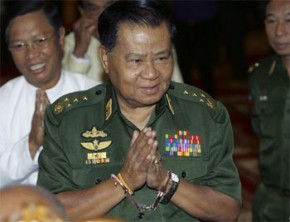
A trusted disciple of Burmese Senior Gen. Than Shwe, the former dictator who is still believed to wield ultimate power over Burma's new government, has reportedly been appointed to lead the country's powerful military intelligence unit.

Maj-Gen Soe Shein, a personal assistant to Than Shwe, has recently taken the helm of Military Affairs Security, as the unit is known, replacing its former chief, Maj-Gen Kyaw Swe, according to security agency sources in Naypyidaw, the country’s capital.

“Before abolishing the former ruling military council, the State Peace and Development Council (SPDC), Senior-Gen Than Shwe promoted Soe Shein from colonel to brigadier-general. Very recently Soe Shein was promoted to major general to take over as the director of the MAS,” a source told The Irrawaddy.

Many observers believe that Than Shwe, chairman of the State Peace and Development Council (SPDC) from 1992 to 2011, has retained his grip on Burma’s military, the country's most powerful institution, despite dissolving the SPDC and officially transferring his former position of commander-in-chief to Gen Min Aung Hlaing. Than Shwe continues to go to his office in the new capital of Naypyidaw on weekdays, working closely with a group of senior generals to keep an eye on the government’s operations. Defense Ministry sources told The Irrawaddy in April that reports from the War Office marked “Confidential” were still being sent to the 77-year-old former ruler, despite his official retirement as head of the military following last year's elections.

Soe Shein's promotion to the position of MAS chief reignites speculation about Than Shwe’s lingering grip on the Burmese military and the new administration led by former military general Thein Sein. For instance, Than Shwe is said to favor a hard line on the ethnic factions that have been fighting a low-level war with the central government for decades. Forces allied with President Thein Sein, the source said, favor negotiations

At least six top generals reportedly have been sacked and arrested since February on the pretext of an investigation into corruption. “Soe Shein is Senior Gen Than Shwe's most trusted man. His appointment as chief of the MAS means that the old man will be watching everyone through constant updates on the current situation,” a Military Affairs Security officer said.

The MAS was created following the dismantling of the former Military Intelligent Service, led by the once-powerful general and former prime minister, Khin Nyunt, who was purged in 2004 and later sentenced to 44 years imprisonment on charges of corruption and insubordination; he is now under house arrest. The MIS was notorious for keeping a watchful eye not only on the country’s ordinary citizens, but also on army officers and political exiles living in the West. The Irrawaddy

Wednesday, August 24, 2011

It's Finally Time to Make Burmese Government Accountable


It is clear — even to her opponents — that Aung San Suu Kyi is not an “ordinary civilian,” which was the term Burma’s vice president, Tin Aung Myint Oo, had used to describe her to US Senator John McCain in June.

Suu Kyi’s first face-to-face meeting with Burmese President Thein Sein at the presidential palace is welcome news. There is no doubt that her high-profile attendance at a government workshop in the capital of Naypyidaw last week is highly significant.

She and the president reportedly enjoyed a cordial conversation, though no details of the meeting were released by either camp. It has also been learned that Thein Sein and his wife hosted Suu Kyi for dinner at the presidential palace.

Burmese state broadcasts on Friday evening and state newspapers on Saturday reported Suu Kyi’s meeting with Thein Sein, and showed pictures and footage of the two sitting for reporters beneath a picture of Suu Kyi’s father, Gen. Aung San, Burma’s independence hero and founder of the Burmese Armed Forces.

Was there a subliminal message here? Suu Kyi’s bold and upright appearance in the photograph appeared as if she were visiting the president on behalf of her father. “What have you done to Burma?” could have been the caption.

State mouthpiece, The New Light of Myanmar, reported the meeting from a different angle: “The president and Daw Aung San Suu Kyi tried to find out the potential common grounds to cooperate in interests [sic] of the nation and the people putting aside different views.”

The news report did not explore further what “potential common grounds” were discussed. But whatever the rhetoric, the apparent progress is certainly heartening.

We were told that Suu Kyi was pleasantly surprised when the government’s liaison, Labor Minister Aung Kyi, invited her to a second round of meetings earlier this month.

Sources in Suu Kyi’s National League for Democracy noted that Aung Kyi no longer played the role of messenger. He appeared to be in a position to negotiate, and had apparently softened his stance and offered some concessions, including the release of some political prisoners.

Informed sources have suggested that at the core of Aung Kyi’s brinkmanship was the fact that the government wants Suu Kyi’s endorsement when it approaches the International Monetary Fund for assistance. Recently, it was reported that the new Burmese government was seeking IMF help to reform its complex foreign exchange system.

At the same time, Suu Kyi herself flexed her political muscle after dissidents and exiled Burmese activists urged her to be more pragmatic at the negotiating table.

Since then, Suu Kyi and her NLD aides have appeared much more savvy, with Suu Kyi’s charisma turning into cool gravitas. At the second meeting between Aung Kyi and Suu Kyi, they made real progress. Without it, Suu Kyi would not have gone to Naypyidaw.

Win Tin, a staunch critic of the regime who spent 19 years in prison, followed suit by softening his tone, saying that he believed dialogue between the government and the opposition party leader was a real possibility.

While in Naypyidaw, Suu Kyi met several important players — though notably not longtime strongman Sr. Gen. Than Shwe. Government cronies, influential businessmen, presidential advisers and several powerful ministers were reportedly pleased to meet her.

Observers are naturally questioning why the government seems to have had a change of heart. Even the cynics, the doubters and the overly cautious among us see reason to feel upbeat.

But this is not the first time Suu Kyi has received privileged treatment from her captors. The year before her convoys were ambushed and dozens were killed in Depayin in May 2003, she and top NLD aides were taken to rural areas on an inspection tour of the government’s “nation-building” projects.

She was also treated with regal respect when regional commanders and officials welcomed her and her party leaders to a tour of dam and road-building projects.

Even her fiercest opponent, Than Shwe, and his top brass conceded to dine with Suu Kyi and her team at that time.

But then it all went pear-shaped. Suu Kyi’s political tours drew hundreds of thousands of supporters wherever she went. The euphoria and adulation for the Nobel Peace Prize laureate convinced the military junta that she must be stopped and she spent the next seven years under house arrest.

This time around, pundits say, the new civilian offshoot of the junta is eager to demonstrate that they are different.

Optimists say that in spite of an ongoing power struggle within the government, Thein Sein, who served under Than Shwe for many years, is more reform-minded and more likely to tolerate opposition. He could find it expedient to make a deal with Suu Kyi.

For the first time in a generation, the reformers within government may have the upper hand.

Be that as it may, critics are quite correct to point out that the government is eager to present a cleaner image ahead of the decision by Asean on whether to allow Burma to chair the regional bloc in 2014. They say the olive branch offered to Suu Kyi and the opposition, as well as an invitation to Burmese exiles to return home, are hollow gestures aimed as gaining international credibility.

During her talks with the labor minister, Suu Kyi reportedly aired widespread concerns about the conflicts in Kachin, Shan and Karen states. Whatever assurances she received, skeptics caution that the military’s divide-and-rule strategy between ethnic and democratic forces will likely come back into play and that ethnic groups will be excluded from the dialogue. In anticipation of this, Burma’s democratic forces and ethnic groups must play ball to ensure national reconciliation takes on a more harmonious quality.

In addition to insisting that ethnic armed groups be included in political dialogue, we must maintain our guarded optimism and keep asking the government to free all political prisoners. Without a successful resolution of these issues, Burma will never achieve peace and stability.

Most argue that whatever deep skepticism exists, it is finally time to move in a direction that will make the government and president of Burma accountable. Of course, everyone wants to see action, not just words. To gauge whether the government is prepared to take those meaningful steps will require Suu Kyi to take that long lonely drive to Naypyidaw several more times.


The Irrawaddy

Aung Zaw is founder and editor of The Irrawaddy magazine. He can be reached at aungzaw@irrawaddy.org.